
Case study
Apex Home ServicesHome & Professional ServicesPaid acquisition, tracking, CRM attribution and revenue reporting
Revenue Attribution System
A revenue attribution system connecting paid acquisition with qualified opportunities, pipeline and commercial outcomes.
Starting point
The operating problembehind the project.
The system starts from the business problem first, then connects only the layers required to improve the path from acquisition to downstream outcomes.
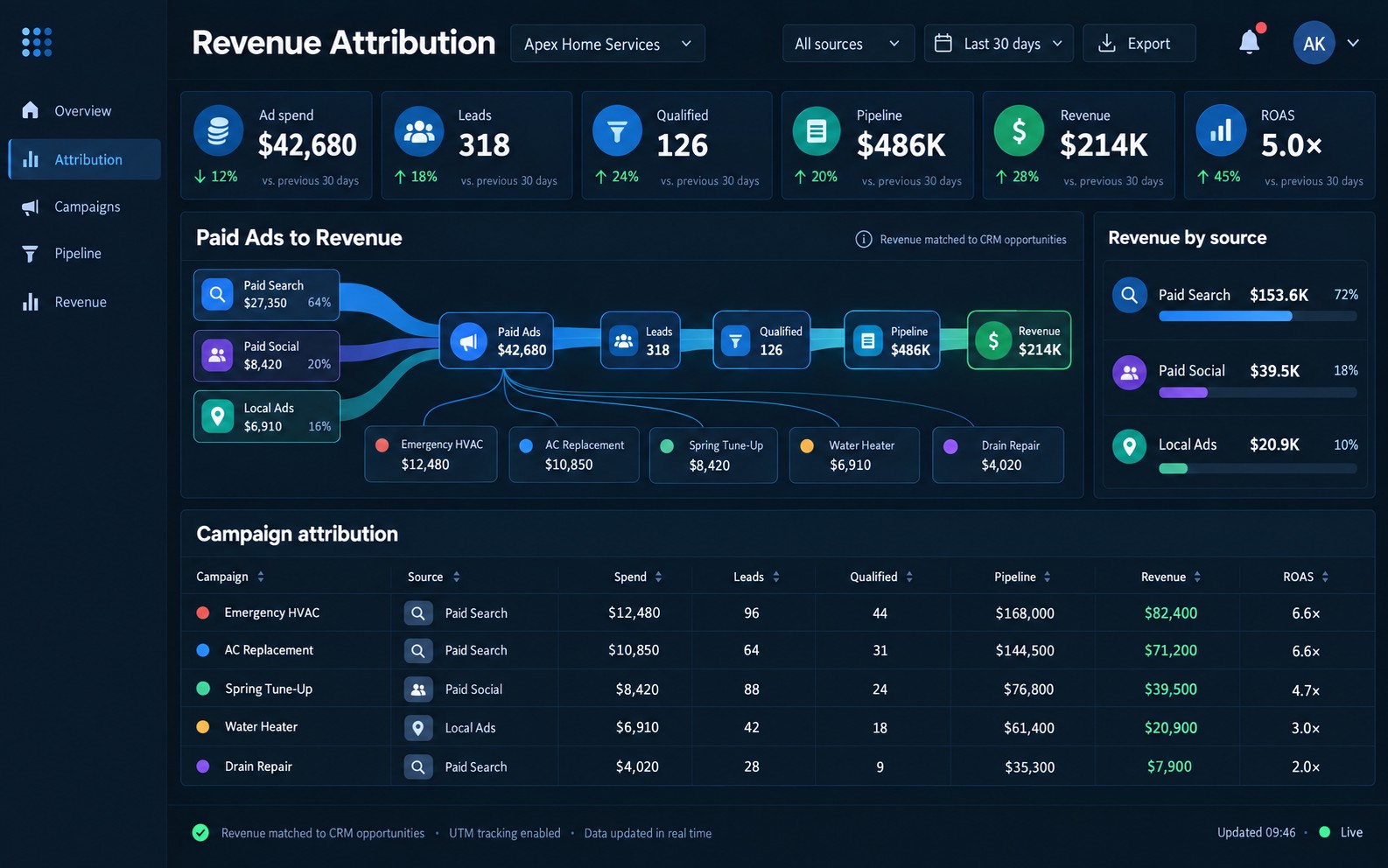
Apex could see clicks, leads and platform-reported conversions, but could not reliably connect marketing campaigns with qualified opportunities, booked work and actual revenue. Budget decisions were being made mainly from CPL rather than commercial performance.
Clicks and leads were visible, but downstream commercial signals were not connected cleanly.
Budget allocation lacked qualified-lead and revenue-level feedback.
Marketing could not reliably judge which sources were producing better business outcomes.
Operating outcome
Measure the systembeyond lead volume.
The operating picture follows downstream signals so acquisition and workflow decisions can be judged against the outcome the system is intended to improve.
Revenue attribution coverage
across tracked acquisition sourcesLower cost per qualified lead
after optimizing beyond raw CPLHigher qualified-lead rate
from paid acquisitionRevenue stages connected
from lead through closed businessMarketing performance could be evaluated against qualified opportunities and revenue instead of lead volume alone, giving the team a stronger basis for budget allocation and campaign decisions.
System built
The operating layerbehind the outcome.
Verlux connects the workflows required around the operating problem instead of forcing every engagement into the same stack.
- 01Campaign and source tracking structure
- 02Lead-source persistence into CRM
- 03Qualified-lead feedback loop
- 04Pipeline-stage attribution
- 05Revenue reporting by acquisition source
- 06Paid-media optimization against downstream outcomes